What you need to know about kitchen cabinet dimensions.
Having accurate information about kitchen cabinet dimensions is a cornerstone of any kitchen design. Cabinet sizes are crucial for efficiently utilizing your living space and creating both an aesthetically pleasing and functional layout in your kitchen. Everyone’s living space, needs, and tastes are different, but familiarity with certain standard measurements greatly facilitates achieving successful results.
Every kitchen can have different corners, wall protrusions, and ceiling heights. This guide, which will help you whether you are building a new kitchen or renovating your existing one, will provide details on which cabinet sizes are preferred and what to consider.
Why are standards important in kitchen cabinets?
Standardization offers significant advantages for both manufacturers and users. When companies that produce kitchen cabinets manufacture them according to specific dimensions, the production of cabinet doors, interior accessories, and assembly becomes faster and more economical. Furthermore, standardized dimensions mean ergonomic and safe use.
Of course, custom sizes are always possible, but commonly used dimensions meet most needs and improve your quality of life. These dimensions, designed to allow for comfortable movement in the kitchen, easy access to utensils, and practicality in kitchen tasks, have been determined based on years of experience.
Turkish Kitchen Furniture: The Name of Quality and Durability
Turkey is renowned for its high-quality standards in kitchen furniture manufacturing. Turkish kitchen furniture holds an important place in the world with its durable materials and aesthetic designs. The meticulous production process ensures long-lasting furniture for kitchens. Modern manufacturing techniques and elegant designs make Turkish kitchen furniture stand out. With a wide range of styles that cater to the needs and tastes of users, Turkish kitchen furniture perfectly complements any kitchen design.
Base Kitchen Cabinet Dimensions
Base cabinets are located directly under your countertop and typically bear the weight of the kitchen. They also house electrical appliances such as the sink, stove, and dishwasher.
In Türkiye and worldwide, some standard dimensions accepted for base cabinets are as follows:
Measurement | Standard Value |
Height | 85 cm ( including countertop ) |
Depth | 60 cm |
Width | It varies depending on the module, usually 40, 50, 60, 80, 100 cm. |
Maintaining a specific height range prevents excessive bending or leaning while working at the countertop . This ergonomic approach provides great comfort for those who spend long periods of time in the kitchen.
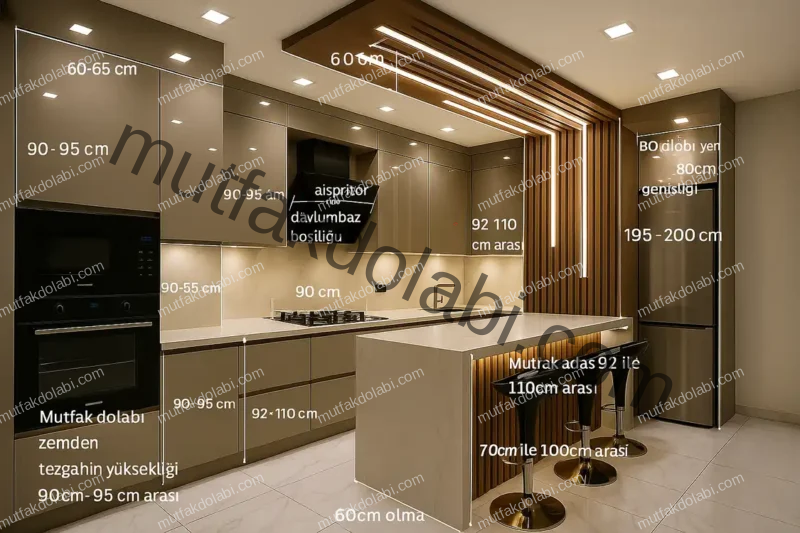
As the depth approaches the standard, your storage space increases, and there are no hard-to-reach dead zones at the back. A depth of 60 cm allows for comfortable placement of countertop tools.
Width can also be a determining factor in the placement of appliances and accessories to be used in the kitchen.
Upper Kitchen Cabinet Dimensions
Upper cabinets are wall-mounted storage areas, typically used for storing everyday items such as plates, glasses, and spices. Since these cabinets often hang in the kitchen, security is more important than ease of access.
Common sizes for these cabinets are as follows:
- Height: 72-92 cm
- Depth: 30-35 cm
- Width: Parallel to the base cabinet modules, 40, 50, 60, 80, 100 cm
The most important factor here is that the upper cabinet shouldn’t be too deep or too high. As the depth increases, opening the cabinet door and accessing its contents becomes more difficult. The height can vary for those who want cabinets that reach the ceiling, but it’s important to ensure it doesn’t exceed an average reach height.
Countertop Height and Depth
countertop height for your workspace is also taken into consideration. The standard countertop height is usually 85 cm. However, if the person is very short or very tall, this figure can be adjusted to 86-91 cm.
Most prefabricated kitchens have a standard countertop depth of 60 cm. This provides a solid base for the lower cabinets and allows your kitchen utensils to be easily placed on the countertop .
the countertop and the upper cabinets is also important. This distance is usually kept between 55-65 cm. This allows you to work comfortably at your countertop and easily access the upper cabinets.
Dimensions Required for Built-in Appliances
Modern kitchens frequently feature built-in appliances such as cooktops, ovens, and dishwashers. While each brand has its own dimensions, the main height and width requirements to consider when installing cabinets are as follows:
- Oven: 60 cm width, 60 cm height
- Dishwasher: 60 cm width, 85 cm height
- Stovetop: 60 cm width
If you are using large-volume products, it would be beneficial to contact the manufacturer to clarify the dimensions.
Corner Cabinets and Custom Solutions
In some kitchens, when an L-shaped or U-shaped layout is adopted, corner spaces can be used inefficiently. However, corner cabinets, if well-designed, offer many advantages in terms of both storage and practicality.
Things to consider when buying corner cabinets:
- The lids open and close easily,
- Maximum use of space with turning devices (such as blind cabinets, rotating shelves, etc.)
- Avoid very deep shelves,
When taking measurements for these areas, leaving an extra 15-20 cm of space at the wall corners from the kitchen countertop will make things easier.
Drawer Module Options
The number and size of drawers in kitchen cabinets are also very important in terms of functionality. Drawers can be designed separately for groups such as cutlery, pots and pans, and small household appliances.
Commonly used drawer heights:
- 10-12 cm (top drawer for spoons and cutlery),
- 20-25 cm (middle drawer for plates, pans or large kitchen utensils),
- 30-35 cm (bottom drawer for deep pots or tall items).
The depth is generally parallel to the overall depth of the cabinet. The width, however, varies within the module boundaries.
Essential Measurement Controls in a Perfect Kitchen
The secret is to be meticulous when taking measurements and to conduct tests that facilitate ease of use. Most professional kitchenware manufacturers take on-site measurements before production and pay attention to certain key details:
- What is the maximum size of the piece that fits through the door in centimeters?
- Is there any wall curvature in the cabinet that will be hung from the ceiling?
- Does the slope of the floor make a difference in the kitchen?
- Do water and electrical installations affect cabinet placement?
- Are additional air gaps necessary for appliance boxes?
The list of ideal dimensions may vary for each kitchen, but the correct implementation always relies on the principle of “measure first, then install.”
Cabinet Dimensions According to Different Kitchen Types
Cabinet dimensions can vary in a small apartment kitchen, a large villa kitchen, or a long, narrow gallery kitchen. The table below shows the recommended maximum and minimum cabinet dimensions for some kitchen types:
Kitchen Type | Base Cabinet Height | Upper Cabinet Height | Base Cabinet Depth | Upper Cabinet Depth |
Standard | 85 cm | 72-92 cm | 60 cm | 30-35 cm |
Kitchenette | 82 cm | 60-72 cm | 50 cm | 25-30 cm |
Spacious Kitchen | 90 cm | 92 cm | 65 cm | 40 cm |
In very small kitchens, the depth and height can be reduced to create more space. In larger kitchens, both storage and ease of use can be increased.
Innovative Approaches in Cabinet Design
In recent years, solutions tailored to changing user habits have been shaping kitchen designs. Functional solutions that maximize efficiency in confined spaces are particularly in demand. Built-in drawers, hidden compartments, pull-out shelves, and multi-purpose corner cabinets are examples of these.
Some practical design suggestions:
- Base cabinets with drawers make items more easily accessible compared to classic cabinets with shelves.
- Recessed bins or recycling units can be located right next to the countertop .
- In kitchens with high ceilings, cabinets that extend to ceiling level can provide both aesthetic appeal and extra storage space.
- Sliding doors are a good option for narrow spaces.
In kitchen design, colors and textures, handle choices, and lighting are just as important as the size of the space in influencing the overall perception.
Common Measurement Mistakes
One of the most important things to be careful about is that even small errors in measurement can cause problems during assembly or use. Common mistakes include:
- Failure to take into account plumbing pipes or electrical outlet locations
- Ignoring the slope of the ceiling
- Failure to consider the actual dimensions of household appliances.
- Incorrect module selection at angled corners.
- The failure to consider door and window openings in the planning.
Avoiding these types of errors will save you time and money.
Every detail will make your kitchen both more organized and more functional. Taking the time and making a good plan will bring satisfaction that you can maintain for many years. Carefully choosing the dimensions of your kitchen cabinets can lead you not only to a stylish kitchen but also to a peaceful and functional living space.